
Motor insurance is one of the most competitive segments in the Indian insurance market. Every year, millions of policies come up for renewal - and a surprising number simply lapse. Quietly. Without anyone really noticing until the books are tallied at quarter-end.
For insurers, this isn't a customer service issue. It's a margin issue. With motor combined ratios often crossing 115%, the segment is loss-making before claims even land. Renewals are the most consistent lever to repair that math, and yet most renewal teams are still running the same playbook from a decade ago: a few SMS reminders, a couple of agent calls, and hope.
AI voice agents are quietly rewriting that playbook - not by replacing human agents, but by being everywhere humans can't be. At scale. In the right language. At the right moment. Every single time.
What Makes Motor Renewals Different
Motor is not life. It's not health. It has its own rhythm - and renewal teams that treat it like just another line of business lose the game before it starts.
There's no "I'll think about it for five years." Every customer makes a fresh renewal decision under time pressure, every twelve months.
A Rs. 200 difference can move a customer. Aggregators have trained the market to compare, and customers do - actively, in the weeks leading up to expiry.
Most renewal decisions happen in the final days before expiry. Miss that moment, and the customer is gone - sometimes to a competitor, sometimes to no one at all.
Customers have to renew. They don't have to renew with you. That makes retention a hand-to-hand fight every twelve months.
A motor renewal team might handle 10,000+ policies a week. That's not a problem you solve by adding more headcount.
Where Insurers Are Losing the Renewal Battle
Most renewal leakage isn't a mystery. It happens in five fairly predictable places - and once you see them, you can't unsee them:
Traditional Renewals
 SMS reminders lost in spam
AI-Led Renewals
 Multi-channel, timed outreach
SMS goes to spam. Emails go unread. Missed calls don't get returned. By the time the customer remembers their policy is up, it has already lapsed.
In the weeks before renewal, customers are quietly gathering quotes online. If your only touch in this period is a transactional reminder, the comparison is happening without you in the room.
Human agents call once, maybe twice. If a customer doesn't pick up, they move on to the next name on the list. The next attempt often never happens.
Once a policy lapses past the grace period, it needs a physical inspection before it can be renewed. Most insurers don't have a workflow to recover these customers - so they don't.
A reminder in English to a customer who prefers Marathi, Tamil, or Bengali is a missed conversation - not a non-responsive customer.
How AI Voice Agents Are Changing the Game
This is where voice AI changes the picture. Not as another channel layered on top of the existing stack, but as a new operating layer for renewals - connecting reminders, conversations, payments, and recovery into one continuous loop.
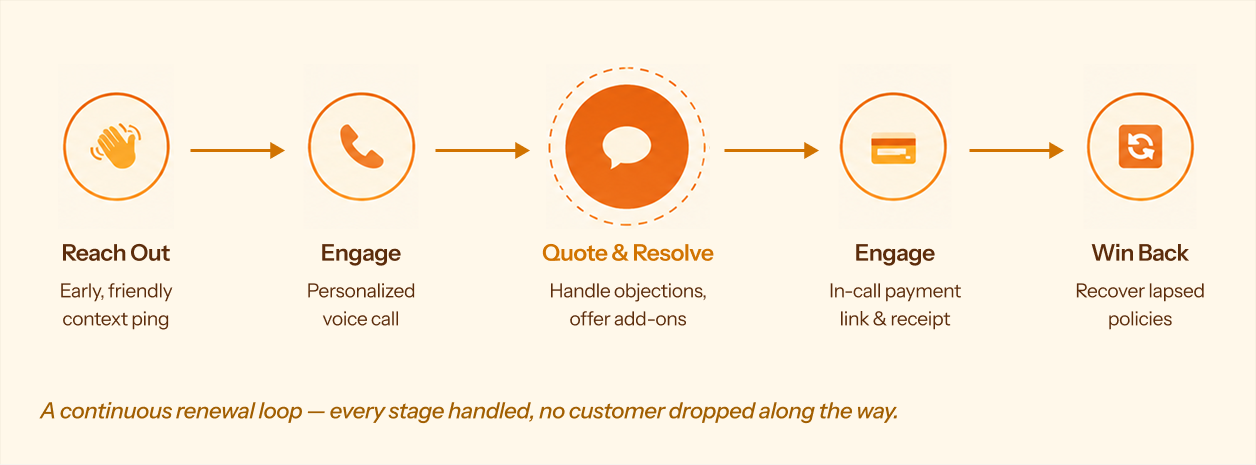
Within that loop, AI voice agents deliver six capabilities a traditional renewal stack simply can't match at scale:
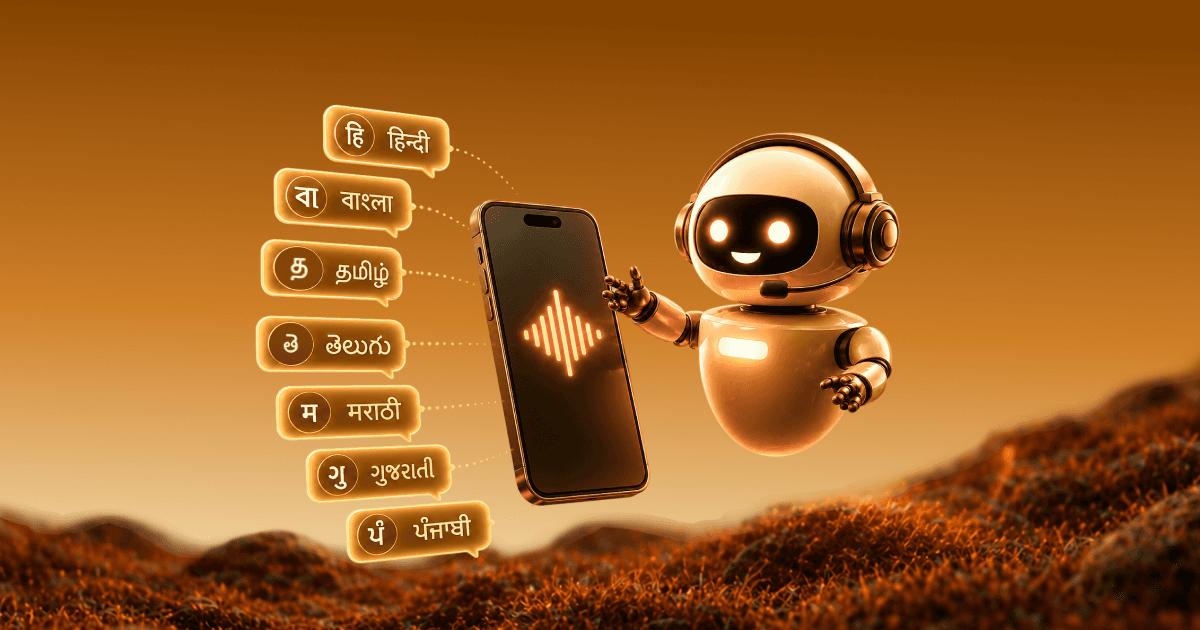
Multilingual reach:
Natural conversations in 10+ Indian languages, including code-switching.
Massive scale:
Thousands of parallel calls without missing a single policyholder.
Right-moment outreach:
Outreach timed to customer intent, not the calendar.
In-call payment:
Payment link on WhatsApp during the call, with receipt confirmed before hangup.
Smart human handoff:
Seamless transfer to a human agent with full call context - no repeating.
Compliance by default:
Recordings, IRDAI disclosures, consent capture, and audit trails - built in.
The result isn't a single new feature. It's a fundamentally different renewal operation - one where every customer gets reached, every objection gets heard, and every lapsed policy gets a real shot at recovery.
The Business Impact for Insurers
The shift from manual to AI-led renewals isn't a small efficiency gain. It's a step-change in retention economics.
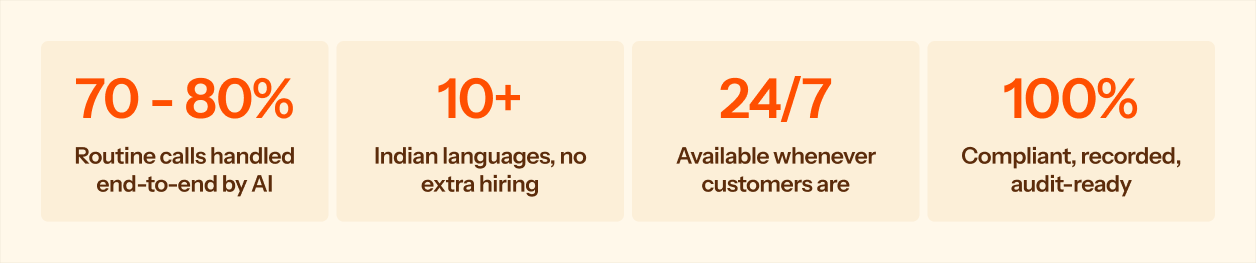
Insurers using AI voice agents typically see meaningful improvements in OD persistency within the first year of deployment.
AI handles routine calls end-to-end, freeing human agents for high-value, complex conversations where their judgment actually matters.
Serve customers across Tier 2 and Tier 3 India in their preferred language - without recruiting and training agents in every region you operate in.
Every call is recorded. IRDAI disclosures are scripted. Consent is captured. Audit trails are clean - without a single manual step from your ops team.
Renewal teams see what's happening as it happens - which cohorts are converting, which objections are surfacing, which add-ons are landing. Decisions stop relying on month-end reports.
Conclusion
Motor renewals will always be a hard problem. The customer is price-sensitive. The window is short. The competition is one click away on an aggregator app.
But the insurers winning at it in 2026 aren't the ones with the biggest call centers. They're the ones with the smartest, most consistent renewal engines - and AI voice agents are quickly becoming the foundation of that engine.
For motor insurance teams looking to turn renewals from a leakage problem into a retention advantage, the question is no longer whether to use voice AI. It's how quickly to make it part of how the team works, every day.