
We've all been there. You call a company with a simple question, and instead of an answer, you get: "Press 1 for billing. Press 2 for support. Press 3 to hear these options again."
By the time you've pressed your way through three menu layers, you've forgotten what you originally called about and you're already frustrated before speaking to a single human.
That's the traditional IVR experience. And in 2026, it's no longer good enough.
The question enterprises are now asking isn't whether to move beyond legacy IVR, it's how fast, and what actually works when they do.
A Quick Recap: What Are We Comparing?
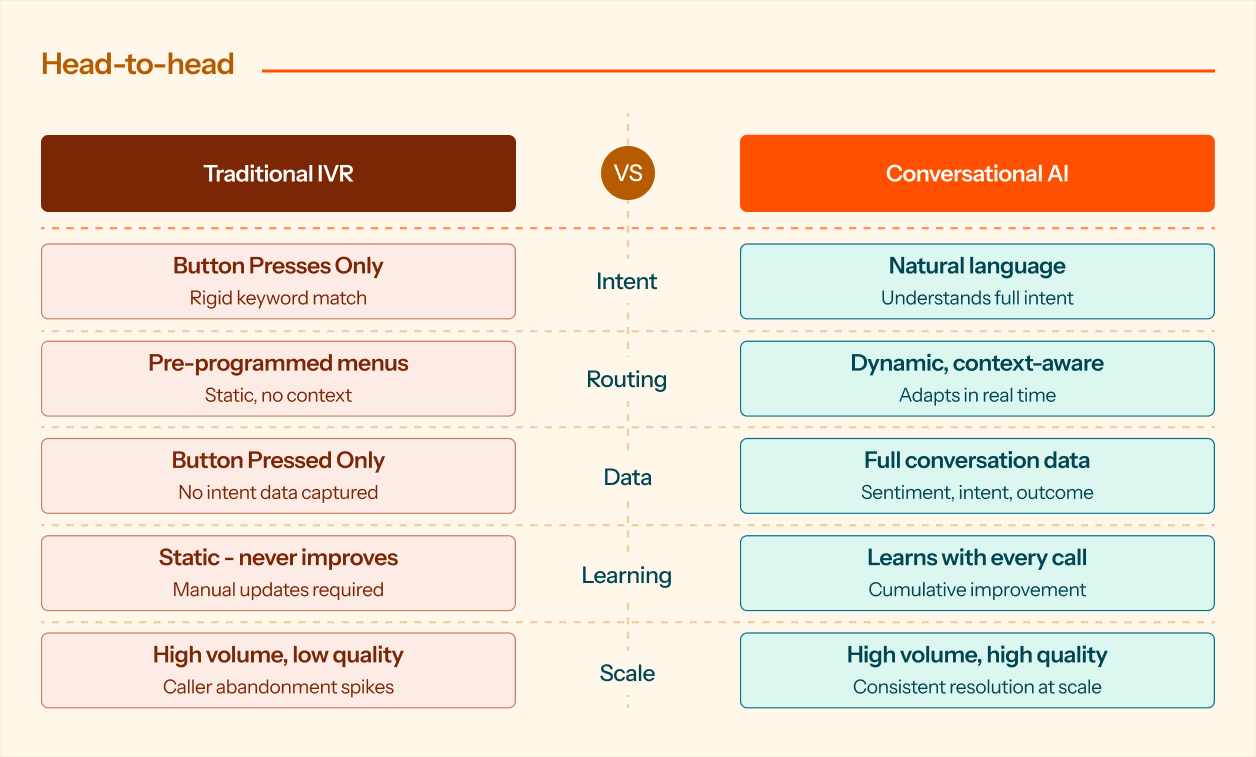
Traditional IVR (Interactive Voice Response) has been the backbone of enterprise call handling for decades. It works through pre-programmed menu trees. A caller presses a number or says a keyword, the system matches it to a predefined option, and routes accordingly. Simple, predictable, and at high volumes, surprisingly brittle.
Conversational AI is a different animal altogether. It uses Natural Language Processing (NLP) and Large Language Models (LLMs) to understand what a caller actually means, not just what button they pressed. It asks questions, adapts in real time, and handles complex, multi-turn conversations without forcing the caller into a rigid script.
Think of it this way:
Traditional IVR is a vending machine : you must select the exact slot to get what you want. Conversational AI is a concierge : you describe what you need, and it figures out the rest.
Where Traditional IVR Is Still Costing You
Here's what the data is showing in 2026:
Between 60–80% of callers hang up when they encounter a complex IVR menu. For a high-volume contact center handling thousands of calls a day, that's not a stat, that's a revenue leak. Every abandoned call is a lead that didn't get qualified, a renewal that didn't get followed up, or a customer who silently churned.
The deeper problem with traditional IVR isn't just that it frustrates callers, it's that it captures almost no useful data. You know which button someone pressed. You don't know why they called, how urgent their need was, what their intent was, or what would have actually resolved their issue. That intelligence gap compounds over time.
There's also the rigidity problem. A high-value enterprise prospect calling about a complex policy gets the same "Press 1 for Sales" treatment as someone calling to check their account balance. IVR doesn't distinguish. It can't. It was never designed to.
What Conversational AI Is Getting Right
The shift isn't theoretical anymore. In 2026, enterprises deploying AI voice agents are reporting measurable, consistent results:
Because conversational AI understands intent and can ask clarifying questions in real time, it resolves more queries end-to-end without handoffs, without transfers, without callbacks. In insurance, for instance, AI agents are now resolving up to 68% of routine policy and claims queries without any human intervention.
When a caller can simply say "I need to check my renewal date" and get an immediate, accurate answer rather than navigating three menu levels, they stay on the call. The experience feels faster because it is faster.
Early conversational AI systems suffered from awkward pauses between a caller speaking and the system responding. In 2026, response latency has dropped below 500 milliseconds in leading platforms which means conversations feel natural, not robotic.
Modern Automatic Speech Recognition (ASR) engines now achieve over 98% accuracy, handling varied accents, background noise, and overlapping speech. The old excuse "our callers have thick accents, the system won't understand them" no longer holds.
Unlike IVR, every conversational AI interaction generates structured data: intent, sentiment, resolution outcome, call duration. That data feeds back into improving the system, which means the platform gets smarter with each call. Traditional IVR doesn't learn. Conversational AI does.
The Nuance: Where IVR Still Has a Role
It would be dishonest to declare IVR completely dead and most enterprises shouldn't treat this as a rip-and-replace decision overnight.
Traditional IVR still works well for very narrow, highly predictable use cases: automated payment by keypad for PCI compliance, simple account balance lookups where security protocol requires DTMF input, or routing queues where the call volume is extreme and the nature of queries is uniformly simple.
The smarter strategy most enterprise CX leaders are adopting in 2026 is a front-end AI, back-end fallback model: deploy AI agents to handle the majority of inbound interactions from the first touchpoint, and retain legacy routing logic only as a fallback for true edge cases or where regulatory constraints demand it.
This approach preserves compliance while dramatically improving the customer experience at the most critical moment, the first 30 seconds of the call.
The Real Challenge: Implementation Is Not Plug-and-Play
Here's what gets glossed over in most conversational AI pitches: transitioning from IVR to AI voice agents is genuinely complex. It requires persona design, conversational flow mapping, CRM and telephony integration, compliance configuration, and rigorous testing before going live.
For enterprises in regulated industries like insurance and banking, the compliance dimension alone is substantial. Conversations need to be auditable. Data needs to be encrypted in transit and at rest. Role-based access controls, SOC 2 certification, ISO and DPDP compliance, these aren't optional extras, they're baseline requirements.
This is exactly why the choice of vendor matters as much as the technology itself. A conversational AI platform that isn't built compliance-first will become a liability, not an asset.
What This Means for Insurance and Banking Specifically
These two sectors sit at an interesting intersection: extremely high call volumes, highly regulated environments, and customers who are often calling during moments of stress or urgency (a claim, a fraud alert, a renewal deadline).
Traditional IVR in these contexts doesn't just frustrate, it actively erodes trust. A customer who is already anxious about a claim and can't navigate a menu tree is a customer writing a complaint, not a customer who renews.
Conversational AI agents in insurance and banking are now handling:
The results in these specific workflows are not incremental.
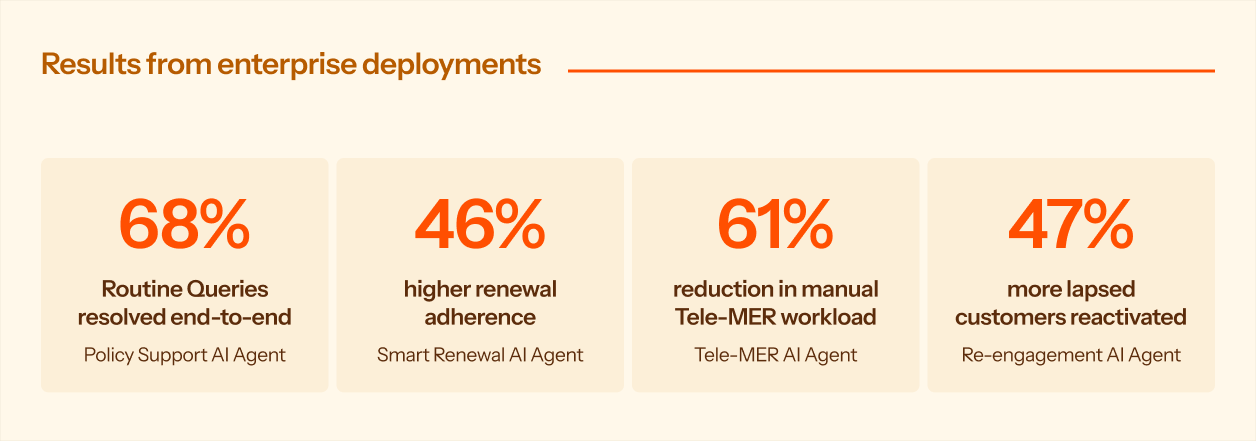
The kind of numbers that move the needle on business KPIs, not just CX scores.
The Bottom Line
In 2026, the IVR vs. conversational AI debate is basically over. Companies still relying only on legacy IVR are paying the price through missed calls, poor data, lower trust, and lost business.
The real question now isn’t whether to switch. It’s whether your setup is compliant, multilingual, connected to your CRM and telephony systems, and able to handle scale without breaking.
The tech is ready. The ROI is proven.
What matters now is how fast you move.