

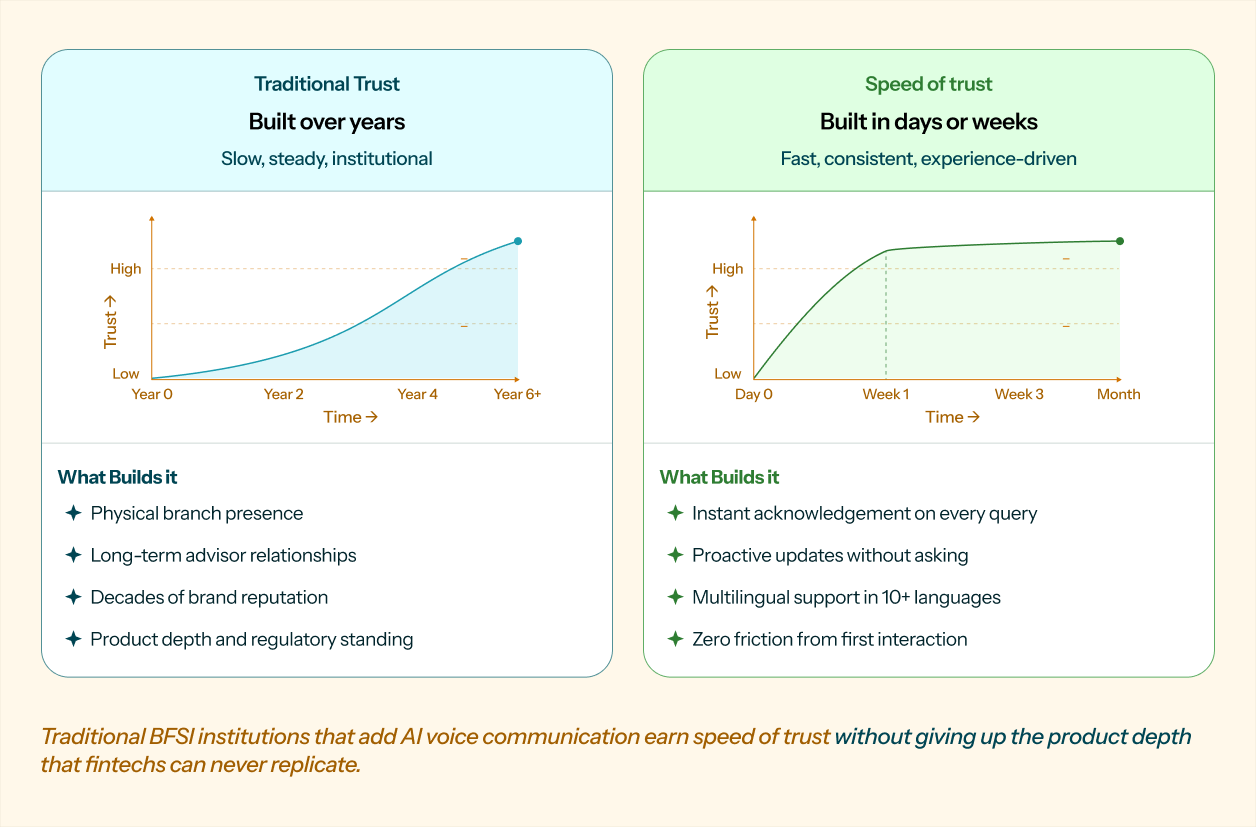
When Zerodha, Groww, and a wave of digital-first fintechs started scaling in India, the assumption among incumbents was clear: regulated financial products like accounts, insurance, and long-term investments require institutional trust. And institutional trust takes decades to build.
That assumption has been substantially revised.
What the fintech wave proved isn't that customers abandoned trust in traditional institutions. It's that customers can extend meaningful trust to a new financial relationship in days, if the experience earns it.
That experience has a name: speed of trust.
What Speed of Trust Actually Is
Speed of trust isn't about how fast a transaction processes. It's about how quickly a customer feels confident that the institution understands their situation, will do what it says, and won't make them work hard to get a simple thing done.
Fintechs built it through: instant acknowledgment, no unnecessary steps, clear communication, and responses that arrived when the customer needed them.
Traditional BFSI built trust through: physical presence, advisor relationships, and decades of institutional reputation.
Both are real. But only one of them works for the customer who is comparing products at 11pm on their phone.
Where the Gap Sits in 2026
| Experience Factor | Fintech (Avg) | Traditional BFSI (Avg) |
|---|---|---|
| Time to first response on query | < 2 minutes | 8-15 minutes |
| Language options for support | 3-5 | 1-2 |
| After-hours support | Yes | Rarely |
| Proactive status updates | Yes | Infrequently |
| Onboarding completion time | 10-15 minutes | 2-5 days |
The gap isn't in the product. It's in the communication layer that surrounds it.
The Opportunity Traditional BFSI Has That Fintechs Never Will
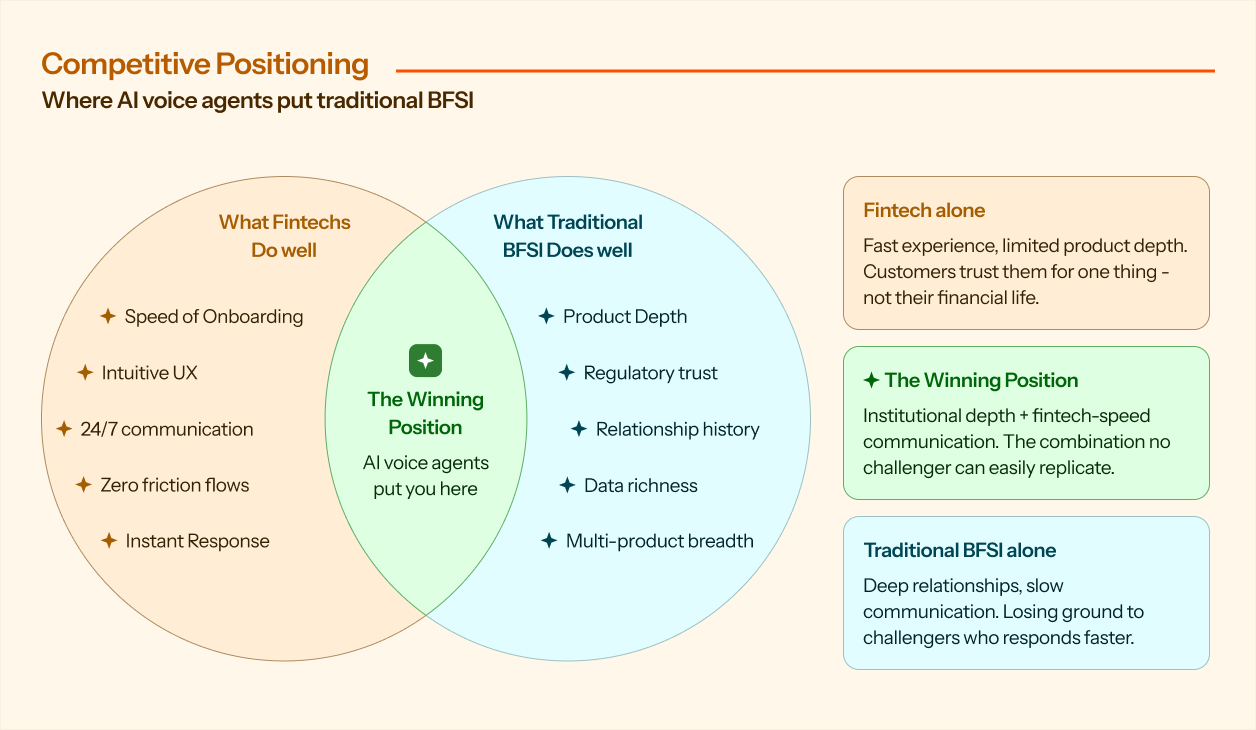
Here's what fintechs can't replicate: depth of relationship.
A customer who has a home loan, a savings account, and an insurance policy with the same institution has a relationship a single-product fintech cannot match. The data is richer. The trust potential is higher. The cross-sell opportunity is real.
The opportunity is to layer speed of trust onto that depth, using AI voice agents to deliver the communication experience fintechs built their early growth on, while retaining the product breadth and institutional credibility that fintechs can't offer.
What AI Voice Agents Specifically Enable Here
Instant acknowledgment on every interaction. Proactive updates without the customer asking. Multilingual support across 10+ Indian languages. Responses that reflect the customer's full relationship, not just the product they called about.
That's the communication layer fintechs built their trust on. It's now available to incumbents at scale. The institutions that deploy it stop losing the communication battle to challengers who have a fraction of their product depth.
The Bottom Line
The fintech lesson isn't that customers abandoned institutional trust. It's that they raised the bar for what earns it.
Speed, clarity, and communication quality now matter as much as reputation and product range. Traditional BFSI institutions that match fintech on communication experience through AI voice agents don't just defend their base. They build a competitive position that no digital-only challenger can easily replicate.