

A customer calls in. They can't reach an agent. They're told: "We'll call you back."
The callback doesn't come.
This interaction, repeated thousands of times a day across BFSI contact centers in India, is so common it has become invisible. Customers have learned not to expect the callback. Operations teams have normalised the failure rate. And the true cost of it has never been fully counted.
What Actually Happens After a Missed Callback
The missed callback isn't a single failure. It's the first event in a cost cascade that ends in churn. And every step in that cascade costs more than the previous one.
Missed callback
A promised follow-up does not happen when the customer was told it would.
Query remains unresolved
Frustration compounds because the original issue still exists and the promise around it was broken.
Customer calls back
A second interaction begins with no shared context, increasing handle time and lowering the chance of resolution.
Customer disengages
Trust drops, receptivity to cross-sell weakens, and churn risk rises quietly.
Competitor wins
The provider that reliably calls back when promised looks more trustworthy, even before product differences matter.
Why the Callback Model Fails at Scale
The callback model has a structural flaw: it asks a human agent to remember, prioritize, and execute a time-sensitive task in the middle of an already high-volume workload.
At scale, the failure rate is not surprising. It is predictable.
The math works against it:
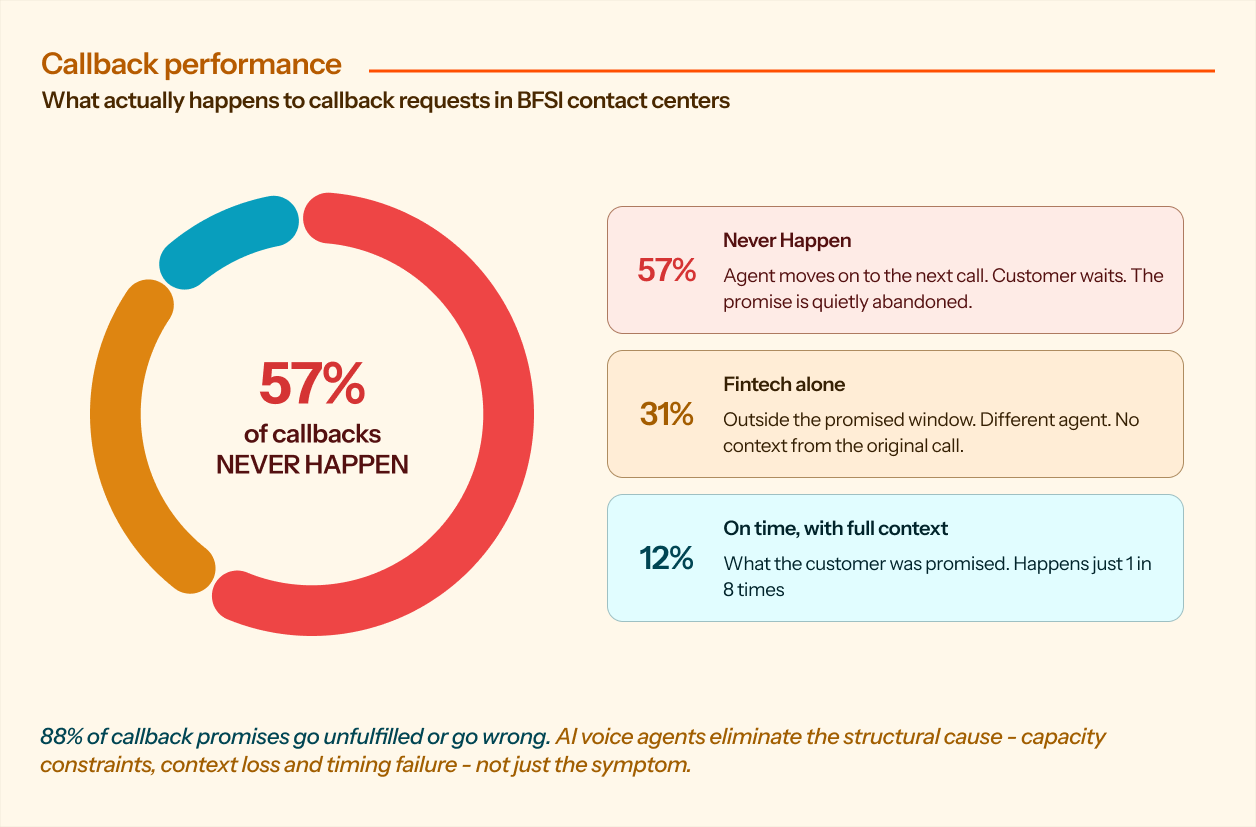
The AI Alternative: Not a Better Queue. A Different Model.
The callback model exists because human agents cannot be everywhere at once. AI voice agents can.
When a customer requests a callback, the right architecture isn't to add that request to a human agent's queue. It's to trigger an AI voice agent that either:
No queue pressure. No context loss. No broken promise.
The customer who was told "we'll call you back between 4 and 6pm" receives a call at 4:12pm that already knows why they called.
That is not a remarkable experience. It is simply what was promised. And in Indian BFSI, consistently delivering what was promised is, by itself, a competitive differentiator.
The Bottom Line
Multiply a single missed callback by the daily volume of a BFSI contact center. Then multiply it across a year. The number of customer relationships quietly eroded by a promise not kept is not small.
AI voice agents that eliminate the structural causes of missed callbacks, capacity constraints, context loss, and timing failure, don't improve an operational metric. They deliver the most basic thing a customer ever asked for: to be called when they said they would.