

In today’s digital-first world, businesses have become highly efficient at generating customer intent. Whether through performance marketing, partnerships, or digital platforms, attracting potential customers is no longer the biggest challenge.
The real challenge begins after a customer expresses interest.
A user fills out a form, requests a quote, or initiates an application. This action signals clear intent, an indication that the customer is ready to engage further. However, in many organizations, the response to this intent is not immediate.
This delay creates what can be described as a hidden operational gap — the gap between customer intent and business response.
While often overlooked, this gap has a direct and measurable impact on conversion rates, customer experience, and operational efficiency.
Understanding Customer Intent in Real Time
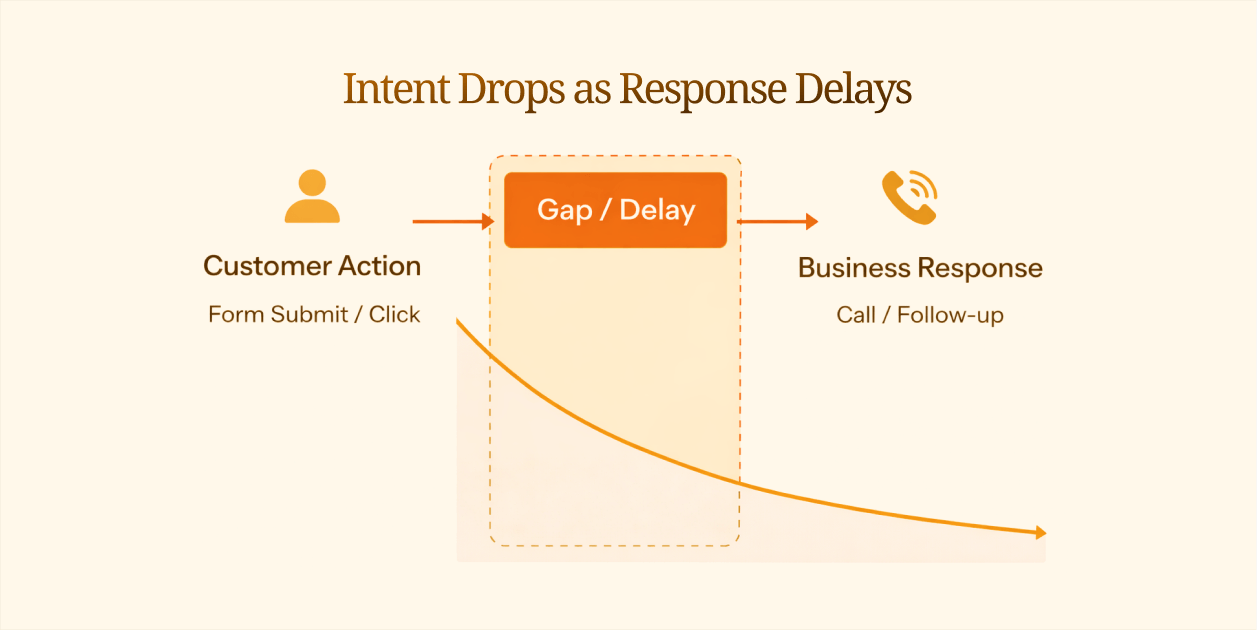
Customer intent is highly time-sensitive. It is strongest at the moment an action is taken such as submitting details or requesting information.
At this point:
- The customer’s context is fresh
- Their interest level is high
- Their willingness to engage is at its peak
However, intent is not static. It begins to decline almost immediately if not acted upon.
This makes timeliness of response a critical factor in determining whether a lead progresses or drops off.
Where the Gap Emerges
In most traditional workflows, the journey from intent to engagement involves multiple steps:
Each of these steps introduces latency.
Even in well-optimized systems, it is common for the first meaningful interaction to occur hours later. In some cases, it may take an entire business day or longer.
By this time, several things may have changed:
- The customer may have explored alternatives
- Their urgency may have reduced
- They may no longer recall the context of their request
This is the point at which intent begins to dissipate.
Why This Gap Often Goes Unnoticed
Despite its impact, this gap is rarely measured directly.Organizations typically focus on metrics such as:
While these metrics are important, they do not capture response latency (the time taken to engage a customer after intent is expressed). As a result, businesses may experience declining conversion rates without clearly identifying the underlying cause.
Operational Constraints Behind the Delay
The persistence of this gap is largely due to structural limitations within traditional customer engagement models. These include:
- Dependence on human agents for outreach
- Fixed working hours and limited availability
- Manual processes for lead assignment and follow-ups
- Variability in execution across teams
Even highly efficient teams face challenges in responding to every customer interaction in real time, especially at scale.
The Business Impact of Delayed Response
The consequences of this delay extend beyond missed calls or slower processes.
The likelihood of conversion decreases as the time between intent and response increases.
Delayed or poorly timed interactions can lead to frustration and disengagement.
In competitive markets, the organization that responds first often gains a significant advantage.
High-quality leads generated through marketing efforts may not translate into outcomes due to delayed engagement.
Moving Toward Real-Time Engagement
To address this challenge, businesses are beginning to rethink how and when customer interactions occur. The focus is shifting from reactive follow-ups to real-time engagement.
This approach emphasizes:
- Immediate response to customer actions
- Automated initiation of conversations
- Structured and consistent interaction flows
By reducing the delay between intent and response, organizations can better align their operations with customer behavior.
Practical Applications
Closing this gap is particularly valuable in processes where timing directly affects outcomes, such as:
In each of these scenarios, faster engagement leads to higher completion rates and improved efficiency.
The Role of Voice AI
Technologies such as Voice AI are enabling businesses to bridge this gap more effectively.
By automating outbound and inbound interactions, Voice AI systems can:
- Initiate conversations instantly based on triggers
- Follow structured workflows consistently
- Capture and process information in real time
- Operate continuously without dependency on human availability
This allows organizations to respond to customer intent at the moment it occurs, rather than after a delay.
Conclusion
The gap between customer intent and business response is subtle but significant.
It does not always appear in dashboards, yet it influences key business outcomes from conversion rates to customer satisfaction.
As customer expectations continue to evolve, the ability to respond in real time is becoming a defining factor for success.
Businesses that recognize and address this gap will be better positioned to convert intent into action efficiently, consistently, and at scale.