

The customer who calls to complain is not your problem. They're still invested. They still want a fix.
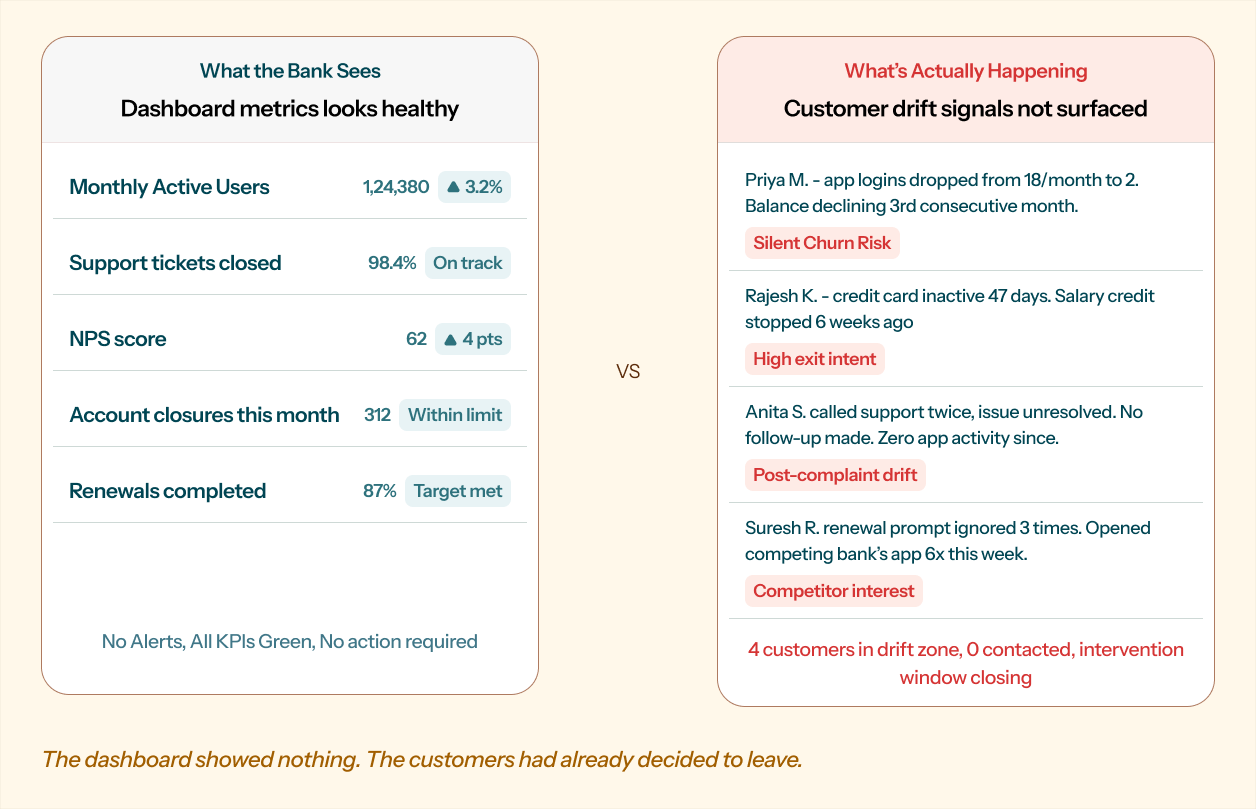
The one you should worry about is quieter. They stopped logging into the app. Their balance is drifting down. They haven't used their credit card in six weeks. And they haven't said a single word to you about any of it.
That's silent churn. And by the time most banks notice it, the customer is already gone.
Why Silent Churners Are Invisible on Most Dashboards
Traditional banking metrics track transactions, ticket closures, and NPS scores. None of them capture behavioral drift - the slow withdrawal of a customer who has mentally moved on but hasn't formally exited yet.
The signals exist. They're just not connected.
The Signals Banks Already Have - But Aren't Acting On
| Behavioral Signal | What It Actually Means |
|---|---|
| App login drops by 50% | Customer disengaging from digital touchpoints |
| Average balance declining 3 months in a row | Funds moving to another bank |
| Credit card inactive for 45+ days | Card being replaced by a competitor |
| Renewal prompt ignored 3 times | No interest in deepening the relationship |
| Complaint lodged, no follow-up, customer never calls back | They gave up |
Each of these signals alone looks like noise. Together, they describe a customer who has already decided to leave - they're just waiting for the right moment.
The 30-90 Day Intervention Window
There is a window between when a customer starts disengaging and when they formally exit. Most banks miss it entirely because their systems are built to react to explicit signals - a closure request, a direct complaint - not behavioral drift.
Customer Disengagement Journey
Engaged
The customer is active across products, balances are stable, and digital behavior looks normal.
First Signal
Small changes appear: fewer logins, lower card usage, or ignored prompts that look harmless in isolation.
Drift Zone
Behavioral signals begin to stack. This is the intervention window - where AI voice agents can act before the decision hardens.
Intent to Exit
The customer is already reallocating attention, balances, and trust toward another provider.
Exit
Closure, dormancy, or full relationship erosion becomes visible only after the retention opportunity is mostly gone.
AI voice agents that monitor behavioral signals in real time can identify customers entering the drift zone and trigger proactive outreach - not a generic campaign, but a personalized call in the customer's language, referencing their actual relationship with the bank.
What That Outreach Looks Like
A customer whose salary credits have slowed and whose app activity has dropped doesn't need a promotional offer. They need someone to reach out and ask if everything is okay.
An AI voice agent with full customer context can do exactly that - in Hindi, Marathi, Tamil, or whichever language the customer actually uses - at the moment the data says they're slipping, not after they've already left.
The Bottom Line
Silent churn is not inevitable. It is a data problem with a conversation solution. The customers leaving without a word aren't beyond saving - they just weren't reached at the right moment.
AI voice agents that act on behavioral signals before the customer makes a formal exit decision are the difference between a retained customer and one your competitor quietly picks up.