

Indian banks and insurers hold some of the richest customer data in the country. Transaction histories going back years. Policy records. Claim patterns. Digital engagement signals. Life event markers, salary changes, new dependents, a home loan, that show up in account behavior before they show up anywhere else.
And the average customer interaction treats them like a complete stranger.
Generic renewal scripts. Outbound calls with no awareness of the customer's recent activity. Complaint handling that starts from scratch every time someone calls in.
The data is there. It's just not reaching the conversation.
Why Data Richness Doesn't Automatically Create Smarter Interactions
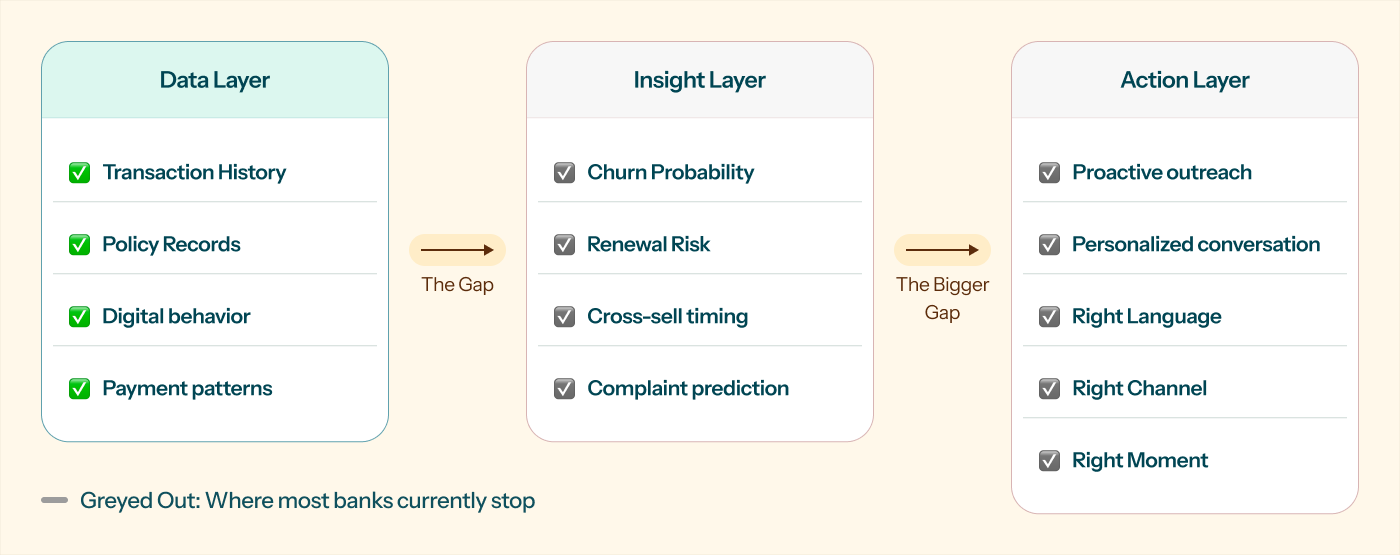
Three structural reasons most BFSI institutions are data-rich and insight-poor:
The core banking system doesn't talk to the CRM. The CRM doesn't talk to the contact center platform. Each system has a version of the customer. No system has the complete customer. And the agent on the call has access to at most one of those systems.'
Even when data integration exists, it's often not live. An agent looking at customer data may be looking at information that is 24 hours old. In a dynamic interaction, outdated context is often worse than no context.
Data tells you what happened. It doesn't tell you what it means, what the customer is likely to do next, or what the right action is. The step from data to actionable insight requires a layer most institutions haven't built yet.
What the Same Data Looks Like When It's Actually Used
Generic call - data-rich but insight-blind:
"Good morning, Mr. Sharma. I'm calling to remind you that your health insurance is due for renewal on July 15th. Would you like to proceed?"
This call knows Mr. Sharma's name and renewal date. That's it. It has no awareness that he had a claim rejected three months ago, called support twice without resolution, and his app engagement has dropped to zero.
AI voice agent call - full customer context:
The agent opening the same call already knows the claim history. The renewal conversation starts differently, acknowledging the experience, addressing the likely objection before it's raised, offering something specific before asking for the renewal commitment.
Same data. Used differently. The outcome is not close.
The Impact of Actually Using What You Know
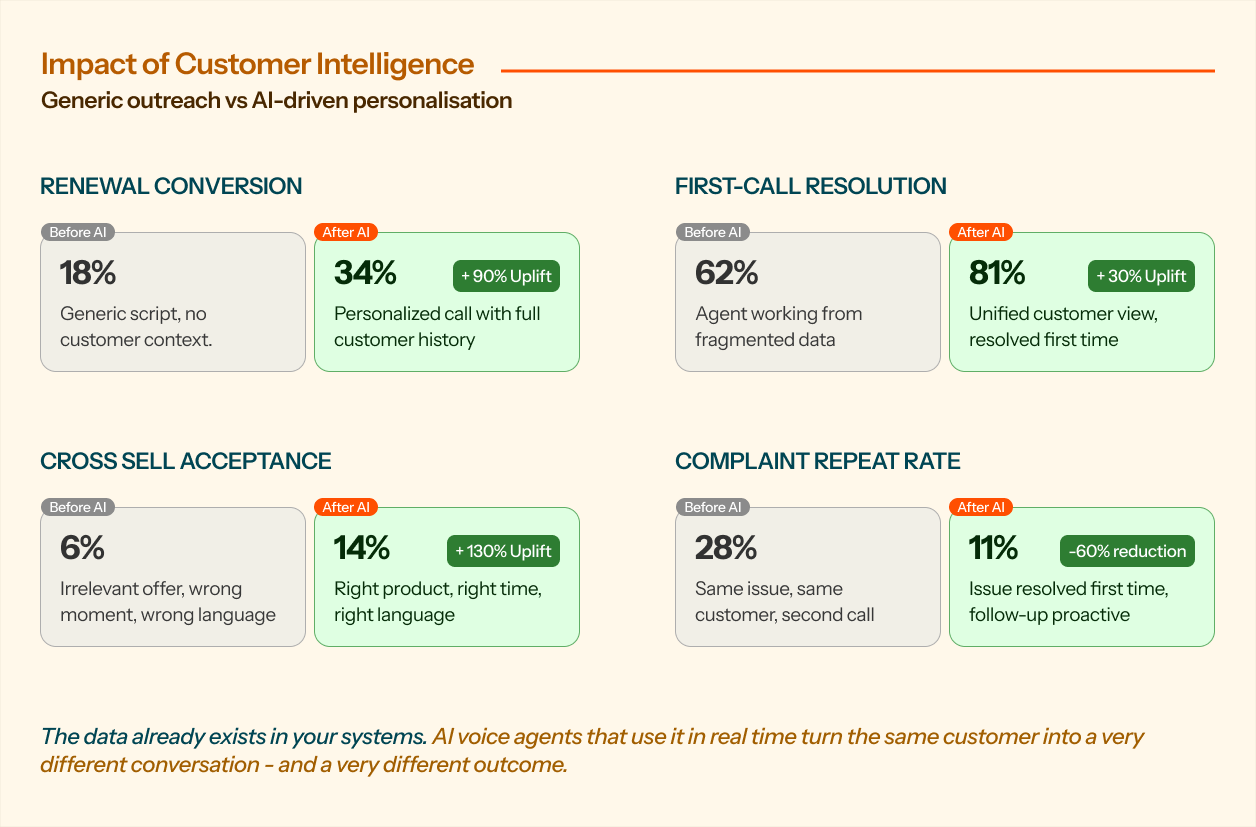
| Metric | Generic Outreach | Intelligence-Driven Outreach |
|---|---|---|
| Renewal conversion | ~18% | ~34% |
| First-call resolution | ~62% | ~81% |
| Cross-sell acceptance | ~6% | ~14% |
| Complaint repeat rate | ~28% | ~11% |
Indicative figures based on industry benchmarks from early AI voice deployments in BFSI.
What AI Voice Agents Specifically Enable
The technical component most BFSI institutions are missing isn't more data. It's the layer that connects existing data to real-time, personalised customer action.
AI voice agents operating with a unified customer view, drawing on transaction data, policy history, interaction records, and behavioral signals simultaneously, generate the insight-to-action connection that human agents working from fragmented systems cannot replicate at scale.
The agent that calls Mr. Sharma knows everything the insurer knows about him. It uses that knowledge before the call starts.
The Bottom Line
Knowing everything about your customers and still getting the interaction wrong isn't a data failure. It's an execution failure.
The data problem in Indian BFSI isn't collection. It's utilisation. AI voice agents that operate with a unified customer view turn the data already sitting in your systems into the conversations your customers have been waiting for.